INNER SNAPSHOT: My camera captures the outer snapshot - what can be seen. The Inner Snapshot captures what can't be seen. Put the two snapshots side by side, and you have the complete moment.
I asked dancers to pick their favorite image from this performance and describe what this exact moment FELT like and why it mattered.
Without their words, these remain beautiful images of skilled dancers. With their words, they become evidence that there's more to a moment than meets the eye, and that we're more than what we look like.
Niko Mulligan: What You Can't See in 'Blinded'
Watching Niko Mulligan move through "Blinded" was like watching someone negotiate with gravity and win.
During the performance and later reviewing the thousands of images from the night, certain dancers demand your attention - not through effort, but through seeming effortlessness. She held each decisive moment just long enough to capture it, suspended mid-air as if on wires, then flowed into the next position with a flexibility that seemed to bend the rules of anatomy.
For this exercise, I asked the dancers to pick one image from the show and articulate four things: What the image actually shows, what is known inherently about the moment but not actually in the frame, what that precise moment meant to them, and what it felt like.
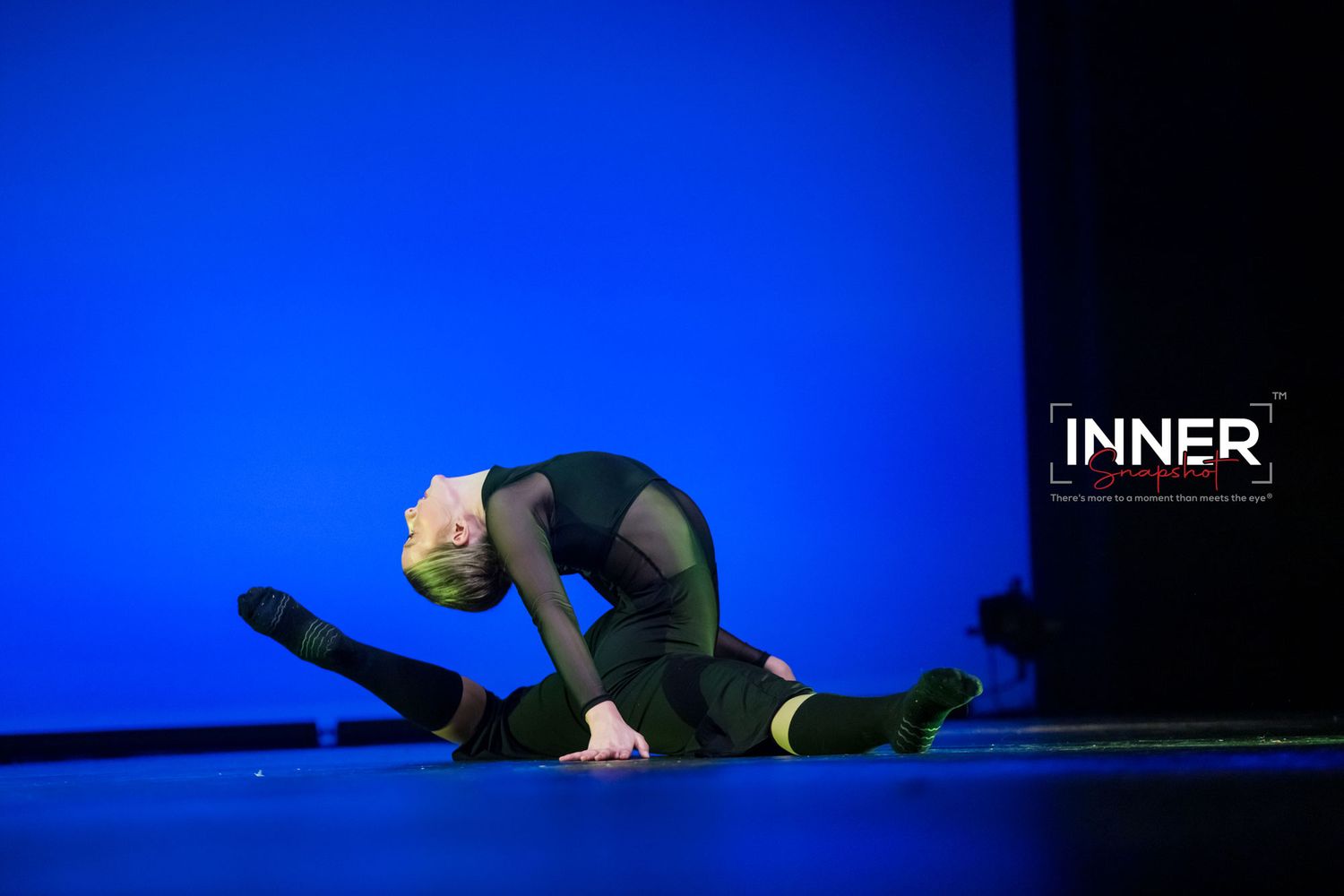
In the image Niko picked, she describes seeing herself "doing a split with a backbend and an attitude with the back leg," wearing a black mesh unitard against blue stage lighting at Clifford E. White Theater on December 10th.
The dance was set to Etta James' "I Would Rather Go Blind."
The image showcases a position she's been working on all year. "I remember this moment because I feel like my flexibility really shows, which is something I have worked on a lot this year," Niko said.
But there's more happening in this frame than technical achievement.
"I was always nervous about this move because I had a headspring right after it, and I would get bruises on the top of my head."
The suspension you see in the frame? It was strategic.
"It felt like I was nervous and tired so I remember trying to use this as a break because the next parts of my dance were the hardest," she said.
This wasn't just a pose - it was a breathing moment before the difficult sections. "I used this part as a place to breathe and slow down," even though "my hips would always hurt on this part."
If I stumbled across this on Instagram, knowing nothing about Niko, I'd have to agree with her that the images turned out great and that they were "cool."
But what you can't see in the image, what was only known to her - and now you (because she said the words out loud), is that these dance images, and this one specifically, "really improved my confidence" because of the way they validated how she felt.
Niko's words changed my perspective.
I've been arguing that photos tell one thing, facts about a moment tell another, and the third and fourth layers are locked inside us.
What this exercise has made me realize is the relationship between all four perspectives, the way they feed off each other to produce an even greater meaning.
But most of all, it shows that we need to capture all four.
For years, I've argued that photographs capture what a moment looks like, but they can't physically capture what a moment means or how that moment felt. For that, you need words because the meaning of a moment is locked inside each of us and NOT in the image we've captured to represent it.
I believed there are three separate layers to a moment: what we can physically see, what is factually known and what it means.
I used to think that these three layers existed independently.
This exercise changed that.
I asked the dancers from Northland Prep's Poetry In Motion performance to pick their favorite photo and answer four questions: What do you SEE? What do you KNOW? What does it MEAN? What did it FEEL like?
What I'm learning is that it's not about three separate layers. It's about the relationship between them. The photo proves what they felt. Their words explain what I captured. The facts anchor the moment in time and space.
Together, they create complete documentation - not just of what happened, but of what it meant to the person living it.
Without their words, these remain beautiful images of skilled dancers.
With their words, they become something more: evidence that there's more to a moment than meets the eye, and that we're more than what we look like.


